Platform Switching and the Pursuit of Pink: What the Esthetic Evidence Actually Shows
A systematic review of 24 clinical studies finds that platform-switching implants improve soft tissue esthetics and stabilise marginal bone — but the advantage over conventional designs is partial, not absolute.
PS helps, but it's not magic
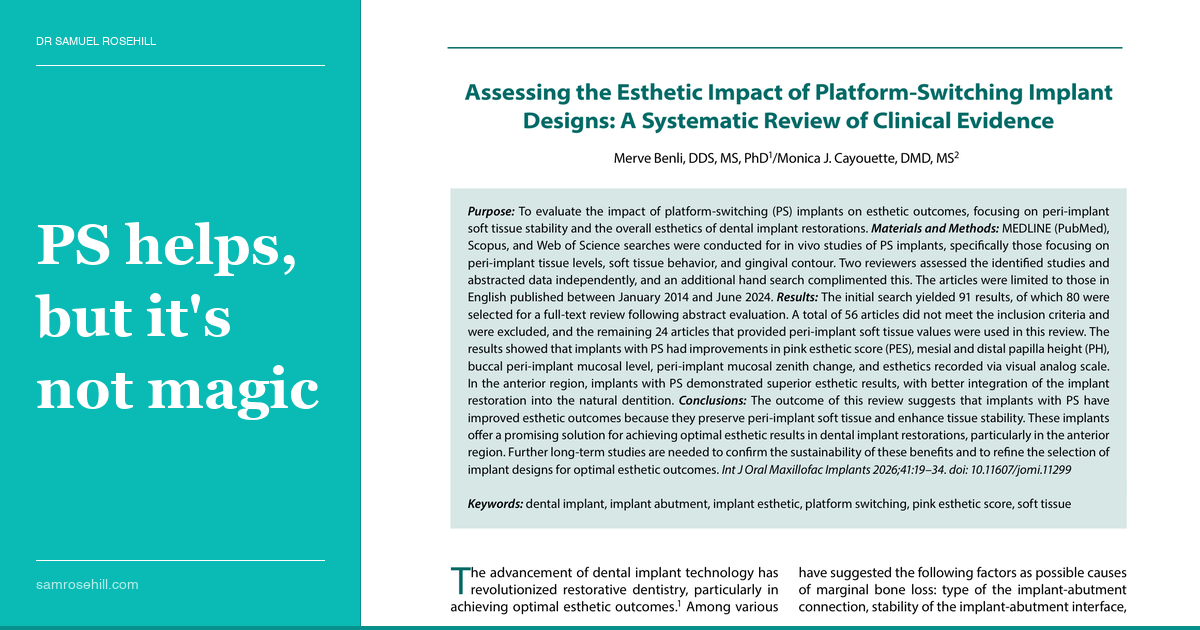
Source Paper
Assessing the Esthetic Impact of Platform-Switching Implant Designs: A Systematic Review of Clinical Evidence
The promise of platform switching has always been elegant in its simplicity: use a narrower abutment than the implant platform, shift the inflammatory cell infiltrate away from the crestal bone, and — the theory goes — preserve the bone that preserves the soft tissue that preserves the smile. It’s a mechanical solution to a biological problem, which is the kind of idea dentistry finds irresistible. The question, two decades into the concept’s clinical life, is whether the esthetic data actually matches the biomechanical logic.
Benli and Cayouette from the University of Florida and Medical University of South Carolina have assembled the answer — or at least the best current version of it — in Assessing the Esthetic Impact of Platform-Switching Implant Designs: A Systematic Review of Clinical Evidence, a systematic review that focuses specifically on what clinicians care about most in the anterior zone: soft tissue stability, gingival contour, and patient-visible outcomes.
The Data Anchor
The review included 24 in vivo studies (10 prospective and 10 randomised controlled trials among them) drawn from PubMed, Web of Science, and Scopus, covering publications from January 2014 to June 2024. All studies involved implants placed in the anterior maxilla or mandible and reported at least one esthetic outcome — pink esthetic score (PES), papilla height, mucosal levels, gingival margin, or patient satisfaction via visual analogue scale. Risk of bias was assessed using ROBINS-I, with 11 of 24 studies classified as low risk and none rated as serious. Follow-up ranged from 6 months to 144 months.
Key Findings
- Short-term marginal bone loss was minimal — pooled estimates centred around 0.75–1 mm, suggesting initial post-loading stability with platform-switched designs. Mid-term MBL showed a more complex picture (−1 mm to 0 mm range), while long-term data trended toward stabilisation or slight bone gain.
- Pink esthetic scores were favourable and stable — short-term PES values ranged from 8 to 14 (mean ~10–12), mid-term values dipped slightly (mean ~6–8), and long-term PES recovered to 8–14, suggesting esthetic outcomes are generally well-maintained over time.
- No statistically significant PES differences were detected between PS and non-PS abutment types when conical, flat-to-flat, and PS designs were compared directly — PES values clustered between 9.8 and 11.55 regardless of connection geometry.
- PS implants showed improvements in papilla height, buccal mucosal level, and peri-implant mucosal zenith change compared to conventional designs, though the null hypothesis was only partially rejected — PS was advantageous for some but not all measured esthetic parameters.
- The honest limitation: the heterogeneity across studies is substantial — different implant systems, varying surgical protocols, inconsistent follow-up periods, and only 15 of 24 studies used photograph-based evaluation. The absence of a meta-analysis limits the strength of pooled conclusions.
Platform switching gives you a better starting position for soft tissue architecture, but the architecture still needs a competent builder.
💡 The Clinical Bottom Line
The evidence supports platform switching as a sound design choice for anterior implants where esthetic outcomes are paramount — marginal bone remains stable, soft tissue parameters trend favourably, and long-term PES scores hold up. But connection geometry alone doesn’t guarantee a beautiful result: implant positioning, the buccal bone wall, soft tissue phenotype, and surgical technique all contribute at least as much as whether the abutment is narrower than the platform. For clinicians already using PS designs, this review validates the approach. For those considering the switch, the data suggests a meaningful but not transformative advantage — one variable in a system where everything from flap design to provisional timing matters.
Dr Samuel Rosehill is a general dentist with a prosthodontic focus, practising at Ethical Dental in Coffs Harbour, NSW. He holds a BDSc (Hons) from the University of Queensland, an MBA, an MMktg, and an MClinDent in Fixed & Removable Prosthodontics (Distinction) from King’s College London.
Reference: Benli, M. & Cayouette, M.J. Assessing the Esthetic Impact of Platform-Switching Implant Designs: A Systematic Review of Clinical Evidence. Int J Oral Maxillofac Implants. 2026;41:19–34. https://doi.org/10.11607/jomi.11299
Clinical Relevance
Platform-switching implants demonstrate improved pink esthetic scores, papilla preservation, and marginal bone stability over short-, mid-, and long-term follow-up, though the esthetic advantage is not uniform across all parameters — material choice alone does not guarantee a beautiful result.
Disclosure: The author has no financial conflicts of interest related to the products or topics discussed in this review. This is an independent summary prepared for educational purposes.
Continue the conversation
This review is also published on Substack, where you can leave comments and join the discussion.
Read on Substack →