One More Bake, and the Optics Start Moving.
Al-Dwairi and Al-Haj Husain show that repeated firing cycles alter both colour stability and translucency in zirconia-reinforced lithium disilicate ceramics, with Vita Ambria High Translucent maintaining the strongest translucency profile across repeated firings.
Extra firings dull optics
Source Paper
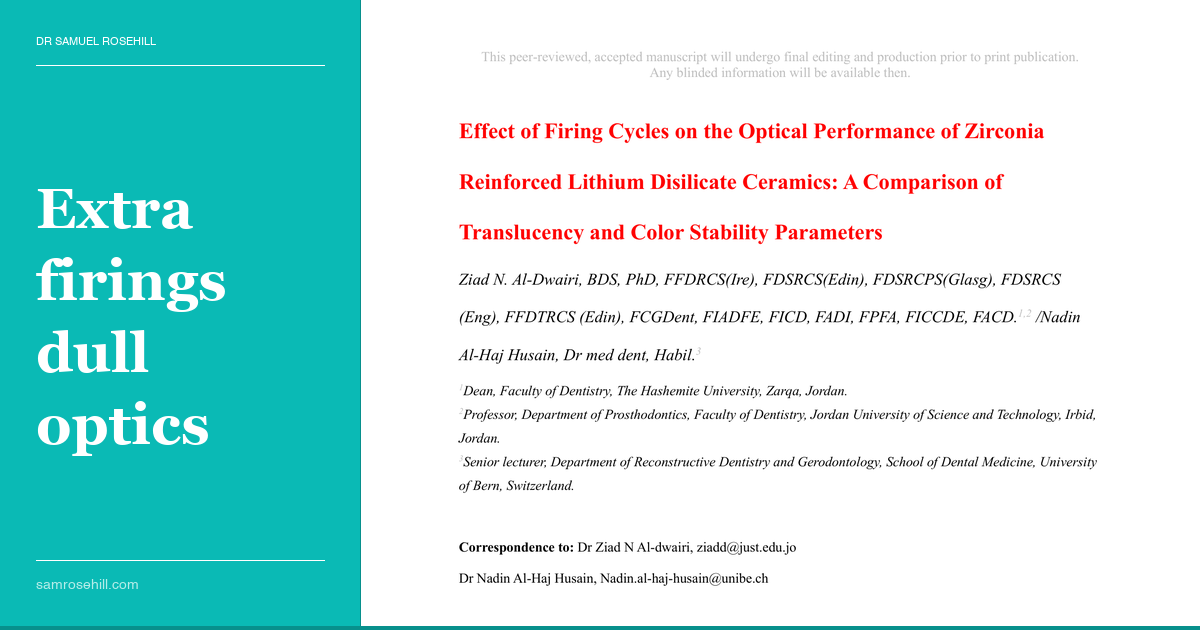
Effect of Firing Cycles on the Optical Performance of Zirconia Reinforced Lithium Disilicate Ceramics: A Comparison of Translucency and Color Stability Parameters
Most of us have, at some point, sent a ceramic restoration back for one more firing with the breezy optimism normally reserved for reheating leftovers. Just tidy the shade. Just soften the characterisation. Just one more turn in the furnace and everyone can go home pleased with themselves. In Effect of Firing Cycles on the Optical Performance of Zirconia Reinforced Lithium Disilicate Ceramics: A Comparison of Translucency and Color Stability Parameters, Ziad N. Al-Dwairi and Nadin Al-Haj Husain ask the materials question lurking beneath that habit. What happens to the optics when the same ceramic keeps going back in? The answer is not disastrous, but it is certainly not free.
Repeated firings altered both colour stability and translucency, and the pattern was not uniform across materials. Which is the awkward part. The extra bake may feel administrative; the ceramic interprets it as an event.
The Data Anchor
This was an in vitro materials study using 45 disk-shaped specimens, all 1.2 mm thick and fabricated in A1 shade. The authors compared three groups: Vita Ambria Translucent, Vita Ambria High Translucent, and IPS e.max Press. Each material was assessed after 1, 3, or 5 firing cycles, with a spectrophotometer used to measure colour difference (ΔE) and translucency parameter (TP).
The statistical message was admirably straightforward. Ceramic type and number of firing cycles both significantly affected mean ΔE (P < .001), and their interaction did too. For translucency, ceramic type and firing cycles again had significant effects (P < .001), although their interaction did not. In other words, material selection mattered, repeat firings mattered, and some combinations kept their composure better than others.
Key Findings
- Vita Ambria High Translucent kept the strongest translucency profile. Across one, three, and five firings, the high-translucent zirconia-reinforced lithium disilicate group showed significantly higher TP values than the other two materials.
- More firings generally meant less translucency. All groups showed a reduction in TP with increasing firing cycles, with IPS e.max Press showing a significant drop after three firings.
- Colour changed as well, and not uniformly. Ceramic type, firing cycles, and their interaction all significantly affected mean ΔE, which is a polite statistical way of saying repeated furnace visits do not treat every material equally.
- The press ceramic looked more vulnerable optically. IPS e.max Press showed significantly higher mean ΔE than Vita Ambria groups across one, three, and five cycles.
- The limitation is obvious, but important. These were standardised discs, not crowns in mouths, so the paper tells us how the materials behave optically under controlled firing conditions rather than how patients will judge them clinically.
💡 The Clinical Bottom Line
If a case is likely to involve repeated correction firings, this paper suggests you should plan for optical drift rather than assume aesthetic neutrality. That applies especially when translucency is doing the heavy lifting in the final result. The laboratory request saying “just one more bake” may be clinically reasonable, but it is not visually innocent.
The practical move is to treat every firing cycle as part of the material prescription, not a clerical afterthought. Furnaces do not merely finish restorations; they edit them.
Dr Samuel Rosehill is a general dentist with a prosthodontic focus, practising at Ethical Dental in Coffs Harbour, NSW. He holds a BDSc (Hons) from the University of Queensland, an MBA, an MMktg, and an MClinDent in Fixed & Removable Prosthodontics (Distinction) from King’s College London.
Clinical Relevance
If a case is likely to need repeated characterisation or correction firings, this paper suggests those extra furnace trips should be treated as optical interventions rather than harmless housekeeping. Material choice matters, particularly when translucency is doing much of the aesthetic work.
Disclosure: The author has no financial conflicts of interest related to the products or topics discussed in this review. This is an independent summary prepared for educational purposes.
Continue the conversation
This review is also published on Substack, where you can leave comments and join the discussion.
Read on Substack →