The Zirconia Bridge Implant That Lost a Third of Its Fixtures
Kohal and colleagues report 5-year outcomes for ZiUnite one-piece 3Y-TZP zirconia implants supporting three-unit fixed dental prostheses, with only 66.67% cumulative implant survival.
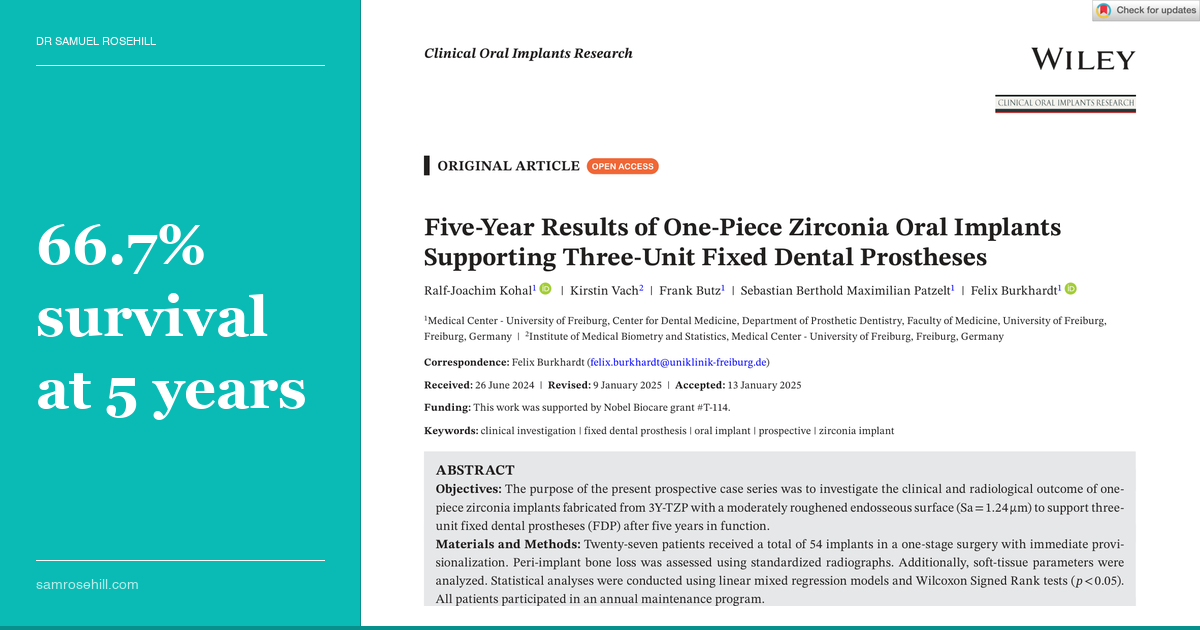
66.7% survival at 5 years
Source Paper
Five-Year Results of One-Piece Zirconia Oral Implants Supporting Three-Unit Fixed Dental Prostheses
Zirconia is very good at looking innocent. It is white, biocompatible, pleasingly metal-free, and tends to arrive in patient conversations wearing the clean linen shirt of modern dentistry. Then the follow-up data walks in with the maintenance chart and ruins the mood.
Kohal and colleagues’ Five-Year Results of One-Piece Zirconia Oral Implants Supporting Three-Unit Fixed Dental Prostheses is not another broad argument about whether zirconia can work. It is narrower and more useful: what happened when the ZiUnite one-piece 3Y-TZP zirconia implant system from Nobel Biocare was asked to support three-unit fixed dental prostheses for five years?
The Data Anchor
This prospective case series included 27 patients who received 54 ZiUnite one-piece zirconia implants fabricated from 3 mol% yttria-stabilised tetragonal zirconia polycrystal (3Y-TZP). The implants had a moderately roughened endosseous surface (Sa = 1.24 μm) using ZiUnite surface technology, and were placed in one-stage surgery with immediate provisionalisation to support three-unit fixed dental prostheses.
All patients were enrolled in an annual maintenance programme. Peri-implant bone loss was assessed on standardised radiographs, with soft tissue parameters recorded over time. By the five-year follow-up, 18 implants had been lost, giving a cumulative survival rate of 66.67%. The surviving implants showed mean marginal bone loss of 1.89 mm, while probing depth, clinical attachment loss and bleeding on probing increased from prosthesis insertion to five years.
The authors attributed implant failure to peri-implantitis, leading to implant removal. They also note that this implant is not commercially available, which is both a limitation and, after reading the survival number, a fairly calming sentence.
Key Findings
- Survival was low for implant-supported prosthodontics. Losing 18 of 54 implants by five years produced a cumulative survival rate of 66.67%.
- The problem was biological, not cosmetic. Failures were attributed to peri-implantitis, with removal required.
- The surviving implants were not pristine. Mean marginal bone loss was 1.89 mm, and PPD, CAL and BOP all increased over the observation period.
- Plaque did not explain the whole story. The plaque index showed no significant change over the same period, which makes the inflammatory deterioration more clinically uncomfortable.
- Generalisability is limited. This was a small prospective case series of a specific non-commercially available one-piece zirconia system, not a verdict on all zirconia implants.
💡 The Clinical Bottom Line
For patients asking about metal-free implants, the answer cannot be “zirconia good” or “zirconia bad”. The answer is system, surface, design, indication, restoration type, maintenance and long-term data; the material name is only the first line of the biography.
This study adds an important negative signal for one-piece zirconia implants supporting three-unit FDPs. It should make clinicians more demanding of evidence, especially when a material arrives with excellent manners and insufficient years behind it. White is not the same thing as harmless.
Dr Samuel Rosehill is a general dentist with a prosthodontic focus, practising at Ethical Dental in Coffs Harbour, NSW. He holds a BDSc (Hons) from the University of Queensland, an MBA, an MMktg, and an MClinDent in Fixed & Removable Prosthodontics (Distinction) from King’s College London.
Clinical Relevance
This prospective case series followed 54 ZiUnite one-piece 3Y-TZP zirconia implants from Nobel Biocare supporting three-unit fixed dental prostheses and found only 66.67% cumulative survival at 5 years. Failures were attributed to peri-implantitis, and surviving implants showed increased probing depth, clinical attachment loss and bleeding on probing over time. The finding is specific to this non-commercially available implant system, but it reinforces the need to judge zirconia implants by long-term system-level evidence, not by material category alone.
Disclosure: The author has no financial conflicts of interest related to the products or topics discussed in this review. This is an independent summary prepared for educational purposes.
Continue the conversation
This review is also published on Substack, where you can leave comments and join the discussion.
Read on Substack →