Drill the Molar Before It Leaves
Gülnergiz and colleagues report 2-year outcomes for pre-extractive interradicular implant bed preparation in immediate molar implants, with 100% survival and 96.3% success in 27 followed patients.
Drill before extraction
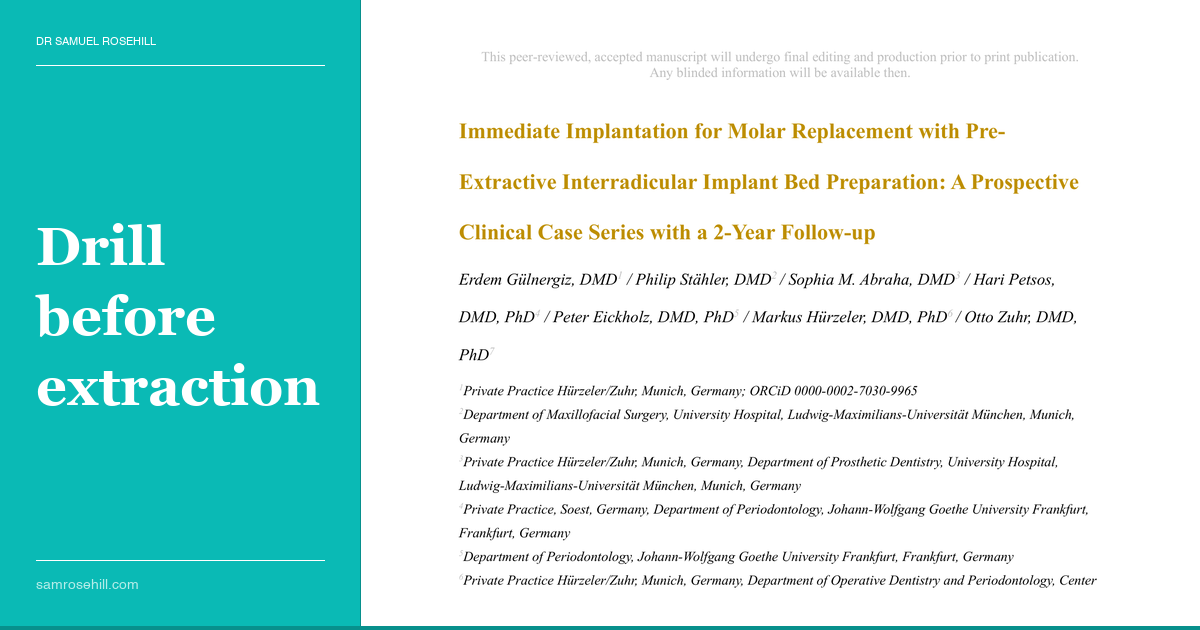
Source Paper
Immediate Implantation for Molar Replacement with Pre-Extractive Interradicular Implant Bed Preparation: A Prospective Clinical Case Series with a 2-Year Follow-up
There is a moment in immediate molar implant placement when the tooth has gone, the socket looks like a small archaeological site, and the interradicular septum is expected to behave with the moral clarity of a surveyor’s peg. It often does not. Gülnergiz and colleagues’ Immediate Implantation for Molar Replacement with Pre-Extractive Interradicular Implant Bed Preparation: A Prospective Clinical Case Series with a 2-Year Follow-up tests a wonderfully literal workaround: prepare the implant bed before extracting the molar.
The idea is not to make immediate molar implants easy. It is to stop the drill wandering once the roots, which were providing orientation and resistance, have been removed from the scene.
The Data Anchor
This prospective case series initially recruited 34 patients, each contributing one untreatable molar. Twenty-seven patients attended both 6- and 24-month re-examinations: 16 men and 11 women, with a mean baseline age of 60.6 ± 14.1 years. Eighteen implants were placed in the mandible and nine in the maxilla.
The protocol reduced the clinical crown, removed restorative and endodontic material, prepared the osteotomy through the intact root complex into the interradicular septum, then separated and extracted the roots before placing the implant into the prepared bed. Success required final insertion torque ≥ 15 Ncm, centred implant position allowing an occlusally screw-retained crown, mean peri-implant probing depths ≤ 5 mm, and no clinical inflammation at 2 years.
At 24 months, implant survival was 100%. Mean final insertion torque was 23.52 ± 8.30 Ncm, transmucosal healing was achieved in all cases, and every implant received an occlusally screw-retained crown. Success was 96.3%, with one biological complication requiring reconstructive surgical correction.
Key Findings
- The positioning problem is the point. Pre-extractive preparation uses the intact molar root complex to guide the osteotomy before extraction turns the socket into a less obedient shape.
- Primary stability was sufficient for transmucosal healing. The mean final insertion torque was 23.52 Ncm, above the study’s ≥ 15 Ncm success threshold.
- The 2-year survival signal was strong. All 27 followed implants survived to 24 months.
- Success was not perfect. One implant developed increased peri-implant probing depths with clinical inflammation, bringing success to 96.3%.
- The caveat is important. This was an uncontrolled case series with seven recruited patients lost to follow-up, and manufacturer-specific insertion torque guidance still matters.
💡 The Clinical Bottom Line
For immediate molar implants, the gold standard problem is three-dimensional control. This paper suggests pre-extractive interradicular bed preparation may help maintain that control by using the tooth as a guide before it is dismantled.
It is not permission to become casual about molar sockets. It is a reminder that surgical sequence is sometimes the instrument: do the orienting step while the anatomy is still kind enough to hold still.
Dr Samuel Rosehill is a general dentist with a prosthodontic focus, practising at Ethical Dental in Coffs Harbour, NSW. He holds a BDSc (Hons) from the University of Queensland, an MBA, an MMktg, and an MClinDent in Fixed & Removable Prosthodontics (Distinction) from King’s College London.
Clinical Relevance
Pre-extractive interradicular implant bed preparation may help clinicians stabilise immediate molar implants in the centre of the socket before extraction removes the root complex as a guide. In this 27-patient case series, 2-year survival was 100% and success was 96.3%, with all implants achieving transmucosal healing and occlusally screw-retained restorations. The technique is promising, but the evidence is uncontrolled and implant-system specific.
Disclosure: The author has no financial conflicts of interest related to the products or topics discussed in this review. This is an independent summary prepared for educational purposes.
Continue the conversation
This review is also published on Substack, where you can leave comments and join the discussion.
Read on Substack →