Resin Infiltration for Fluorosis Looks Compelling — Until You Read the Footnotes
A 2025 systematic review and meta-analysis of six RCTs finds resin infiltration outperforms bleaching and microabrasion for masking dental fluorosis (ΔE 5.41), but I² values reaching 99.84% and confirmed publication bias for the esthetic improvement outcome demand a sceptical reading of those forest plots.
Promising but fragile evidence
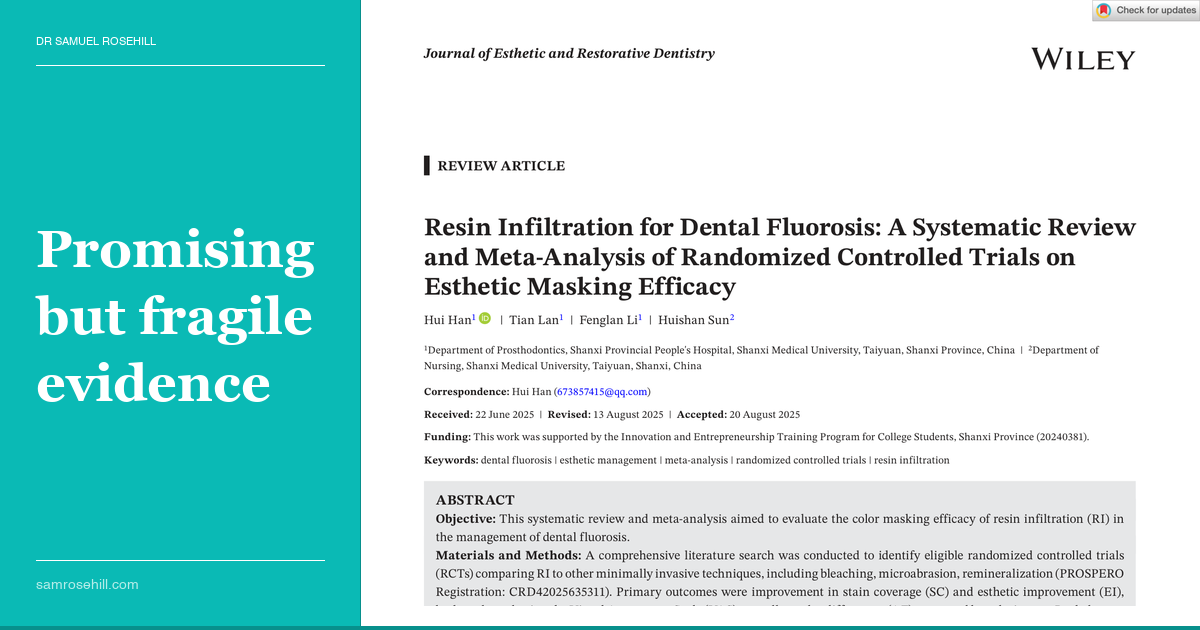
Source Paper
Resin Infiltration for Dental Fluorosis: A Systematic Review and Meta-Analysis of Randomized Controlled Trials on Esthetic Masking Efficacy
A meta-analysis is a peculiar scientific document. On the front page, it offers a headline number (a pooled effect size, a mean difference, a confidence interval that looks pleasingly narrow), and that number tends to travel. It gets cited, repeated at conferences, dropped into treatment-planning conversations as though it came down from a mountain.
And then, a few pages in, the same paper quietly reports an I² of 99.84%, which is statistics’ way of saying that the studies it pooled are so different from each other that the headline number is, at best, a very optimistic average of very different things. Han and colleagues’ 2025 paper in the Journal of Esthetic and Restorative Dentistry, titled “Resin Infiltration for Dental Fluorosis: A Systematic Review and Meta-Analysis of Randomized Controlled Trials on Esthetic Masking Efficacy,” makes a compelling case for resin infiltration. It also tells you exactly why that case is shakier than the forest plots suggest, if you read far enough.
The Data Anchor
The review is PROSPERO-registered (CRD42025635311), PRISMA-compliant, and restricted to randomised controlled trials only. From 874 records searched across PubMed, EMBASE, Web of Science, CENTRAL, and ClinicalTrials.gov, six RCTs met inclusion criteria, yielding 11 pairwise comparisons. RI was compared against bleaching, microabrasion, and remineralization in patients with mild-to-moderate dental fluorosis, predominantly children and adolescents. The primary outcomes were stain coverage (SC) and esthetic improvement (EI), both assessed by Visual Assessment Scale (VAS), alongside colorimetric colour difference (ΔE) by spectrophotometry. Follow-up ranged from immediate postoperative to nine months; a duration the authors note falls well short of the three-to-five-year horizon that restorative material trials typically require.
The pooled results favour RI across all three outcomes. Stain coverage improved by a mean difference of 1.89 (95% CI: 0.17–3.61, p = 0.031, moderate certainty). Esthetic improvement came in at MD = 2.28 (95% CI: 0.73–3.84, p = 0.004; low certainty, with Egger’s test returning p = 0.002, confirming publication bias). The headline colour difference result is MD = 5.41 (95% CI: 3.70–7.12, p < 0.001, moderate certainty), sitting atop an I² of 99.84%.
Key Findings
- RI outperformed bleaching on VAS stain coverage (MD = 2.41, p = 0.022) and esthetic improvement (MD = 2.64, p = 0.006) in mild-to-moderate fluorosis
- RI versus microabrasion was inconsistent: one trial found no VAS difference; another showed ΔE 1.77 higher (p = 0.001) for RI
- The pooled ΔE of 5.41 sits on I² = 99.84%: the studies it summarises are so heterogeneous that this headline figure should be held lightly
- Publication bias confirmed for the EI outcome (Egger’s test p = 0.002); GRADE rates EI evidence low certainty, the wobbliest leg of the analysis
- SC result is fragile: removing any single study renders it non-significant
- Follow-up ceiling is nine months, well short of the three-to-five-year standard for restorative materials
GRADE assigns moderate certainty to SC and ΔE (⊕⊕⊕◯), and low certainty to EI (⊕⊕◯◯). The RI arms for VAS outcomes contained 55 teeth. Not patients. Teeth.
💡 The Clinical Bottom Line
Resin infiltration is almost certainly doing something real for fluorosis aesthetics, and Han and colleagues have assembled the best available evidence to show it. For a child with mild-to-moderate fluorosis and a parent asking whether there is something less drastic than veneers, RI is a genuinely defensible first option: minimally invasive, supported by consistent directionality across trials, and with the basic science mechanism (matching the refractive index of porous enamel) well understood.
The honest conversation with that parent, though, involves acknowledging that the comparison data is built on six small RCTs with a nine-month ceiling. It involves knowing that the EI outcome (the one that captures what patients actually perceive) carries confirmed publication bias, which means the journals likely received and published the encouraging RI results while the less flattering ones stayed in researchers’ drawers. A meta-analysis can only pool what got published.
The headline number will circulate. The I² of 99.84% will not.
Dr Samuel Rosehill is a general dentist with a prosthodontic focus, practising at Ethical Dental in Coffs Harbour, NSW. He holds a BDSc (Hons) from the University of Queensland, an MBA, an MMktg, and an MClinDent in Fixed & Removable Prosthodontics (Distinction) from King’s College London.
Clinical Relevance
Resin infiltration produces statistically superior colour masking in mild-to-moderate fluorosis compared to bleaching and microabrasion, with a pooled ΔE advantage of 5.41. However, the evidence base is small (six RCTs, short follow-ups of up to nine months) and heterogeneity is extreme (I² up to 99.84%), meaning clinicians should treat resin infiltration as a promising first-line option rather than a proven gold standard. The EI outcome carries confirmed publication bias.
Disclosure: The author has no financial conflicts of interest related to the products or topics discussed in this review. This is an independent summary prepared for educational purposes.
Continue the conversation
This review is also published on Substack, where you can leave comments and join the discussion.
Read on Substack →