Leaving the Root Saved the Ridge.
An 80-patient randomized controlled study found that a modified socket shield technique, used without immediate implant placement, preserved buccal plate height and ridge width better than spontaneous healing and produced higher primary stability at delayed implant placement.
Shield preserved the ridge
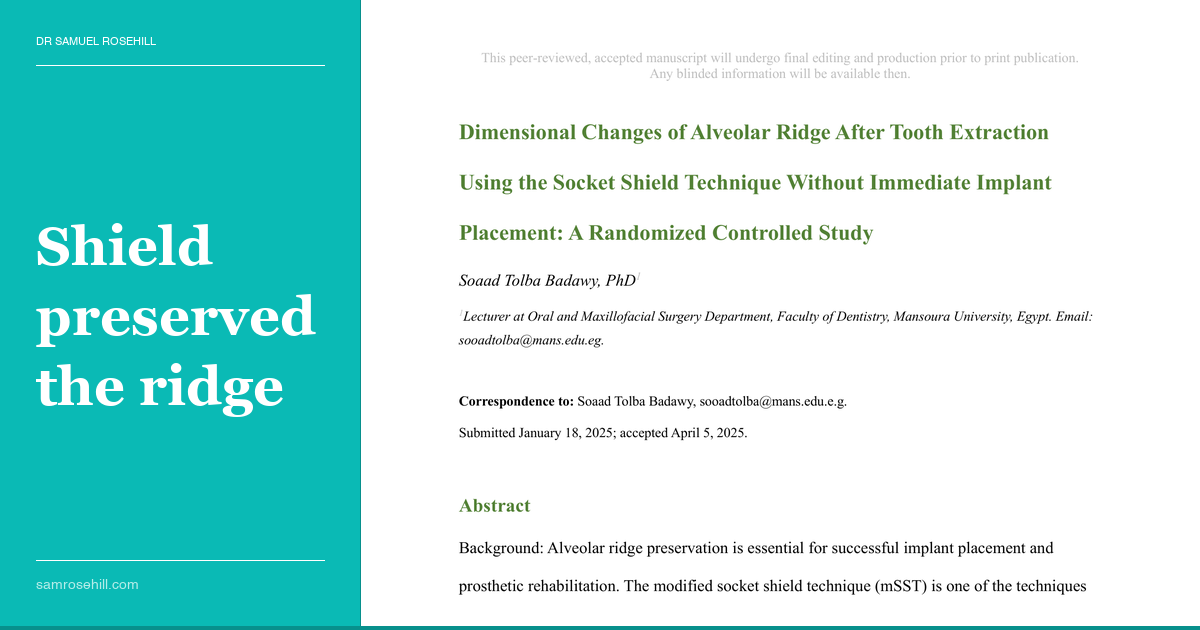
Source Paper
Dimensional Changes of Alveolar Ridge After Tooth Extraction Using the Socket Shield Technique Without Immediate Implant Placement: A Randomized Controlled Study
Dentistry has produced a technique in which the path to better ridge preservation involves deliberately leaving part of a root behind and then congratulating oneself for being conservative. It sounds faintly like sabotage until you read Dimensional Changes of Alveolar Ridge After Tooth Extraction Using the Socket Shield Technique Without Immediate Implant Placement: A Randomized Controlled Study, where Soaad Tolba Badawy tests whether the modified socket shield technique can preserve the ridge when an implant is not being placed immediately. On these data, the answer is yes, particularly where the buccal plate and ridge width are concerned.
That will please the clinicians who have always suspected that spontaneous healing has a nasty habit of sending the buccal contour quietly out the back door while everyone is still admiring the extraction.
The Data Anchor
This randomised clinical study included 80 patients with a single non-restorable non-molar maxillary tooth, divided equally into a test group treated with the modified socket shield technique and a control group treated with atraumatic extraction followed by spontaneous healing. Cone beam CT scans were taken at baseline and again 6 months later. The measurements included ridge width at 1 mm, 3 mm, and 5 mm, together with buccal and palatal plate heights. After healing, implants were placed and primary stability was assessed.
This is what makes the paper useful. It is not merely another abstract meditation on preserving tissue architecture in the esthetic zone. It follows that preservation question all the way to the point where the delayed implant actually has to be placed, which is the moment many elegant ridge-preservation ideas discover they have been writing cheques the osteotomy cannot cash.
Key Findings
- The socket shield group lost less where it mattered most. Compared with spontaneous healing, the modified socket shield technique produced significantly less buccal wall height and ridge width resorption (P < .05).
- The control group behaved the way extraction sites so often do. In the spontaneous-healing group, there were significant decreases in buccal plate height, palatal plate height, and ridge width over the 6-month interval (P < .05).
- The test group’s main concession was the palatal wall. Within the socket shield group, palatal wall height still reduced significantly (P < .001), while other parameters did not show significant change.
- Primary stability was better when the implant finally went in. The socket shield group showed significantly higher primary stability than the control group (P = .001), which is not a trivial downstream benefit when the whole point of the exercise is to make delayed implantation less awkward.
- Not every wall was rescued equally. Between groups, palatal plate height resorption was not significantly different (P = .507), which is a useful reminder that this is not a magic trick so much as a targeted one.
💡 The Clinical Bottom Line
If immediate implant placement is off the table, this study makes a strong practical case for the modified socket shield technique as a way of preserving the buccal contour and ridge width before delayed implantation. The real attraction is not that it sounds clever at a lecture podium; it is that the site appears to come back later in a more implant-friendly mood.
That said, this is still a technique-sensitive approach, not a universal replacement for judgement. The root fragment has to earn its keep, and in the wrong hands it may become less a shield than an administrative complication with delusions of grandeur.
Dr Samuel Rosehill is a general dentist with a prosthodontic focus, practising at Ethical Dental in Coffs Harbour, NSW. He holds a BDSc (Hons) from the University of Queensland, an MBA, an MMktg, and an MClinDent in Fixed & Removable Prosthodontics (Distinction) from King’s College London.
Clinical Relevance
When immediate implant placement is not advisable, the modified socket shield technique may preserve the buccal plate and ridge width better than spontaneous healing alone. The attraction here is not novelty for novelty's sake, but a more stable site and stronger primary stability when the delayed implant finally goes in.
Disclosure: The author has no financial conflicts of interest related to the products or topics discussed in this review. This is an independent summary prepared for educational purposes.
Continue the conversation
This review is also published on Substack, where you can leave comments and join the discussion.
Read on Substack →