The Zirconia Abutment Changed Early. The Outcome Didn't.
A 26-patient randomized trial of flapless immediate implants in the anterior maxilla found no significant 1-year difference in marginal bone, Pink Esthetic Score, or OHIP when the definitive zirconia abutment was placed at 4 days rather than 3 months.
Timing changed little
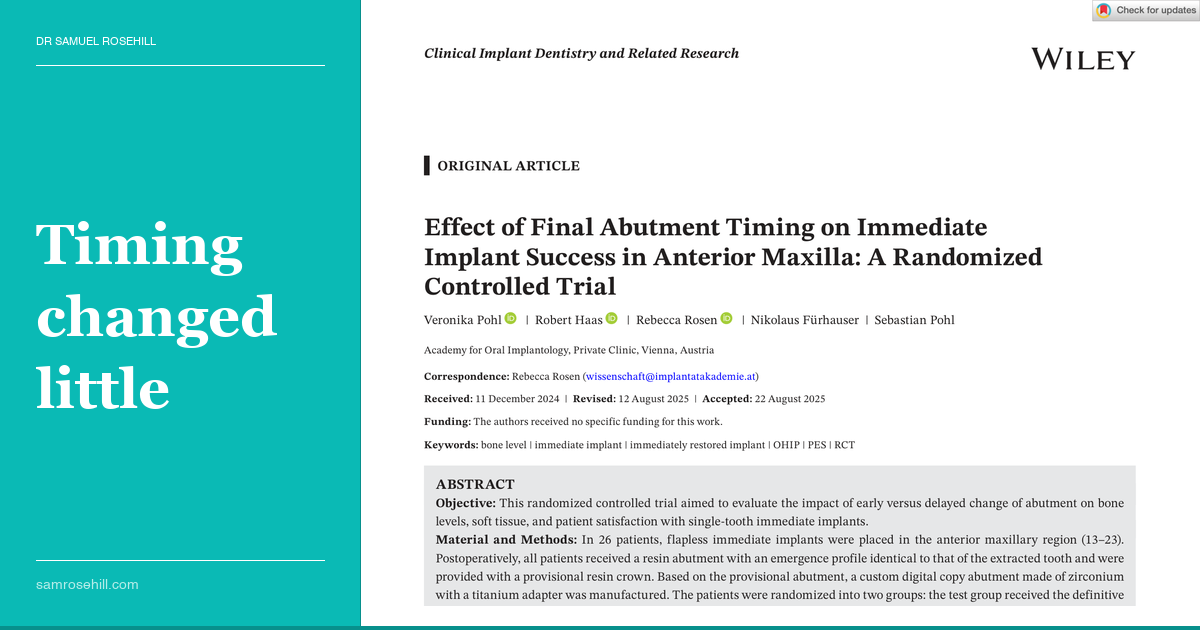
Source Paper
Effect of Final Abutment Timing on Immediate Implant Success in Anterior Maxilla: A Randomized Controlled Trial
Implant dentistry loves turning tiny protocol choices into matters of destiny. Pohl and colleagues, in “Effect of Final Abutment Timing on Immediate Implant Success in Anterior Maxilla: A Randomized Controlled Trial,” took one of the profession’s more persistent hunches and tested it properly.
If you swap the definitive zirconia abutment into an immediate anterior implant at 4 days rather than waiting 3 months, do the tissues reward you? In this study, they mostly shrugged. The earlier change did not produce a statistically significant advantage in marginal bone, esthetics, or oral health-related quality of life after 1 year.
The Data Anchor
This randomized controlled trial included 26 patients needing replacement of a single anterior maxillary tooth between 13 and 23. All cases were carefully filtered: good oral hygiene, intact buccal plate, acceptable soft tissue profile, and primary stability of at least 30 Ncm to permit immediate loading. Every tooth was extracted flaplessly, implants were placed through partially guided surgery by the same surgeon, and patients received a provisional resin crown straight away.
Patients were then randomized into two workflows. In the test group, a custom zirconia abutment on a titanium adapter was inserted 4 days after surgery. In the control group, the definitive abutment was placed after 3 months. Both groups received the definitive ceramic crown at 3 months. The primary outcome was marginal bone level at 1 year; Pink Esthetic Score (PES) and Oral Health Impact Profile (OHIP) were secondary outcomes.
Key Findings
- Bone levels did not separate in a clinically persuasive way. Mean marginal bone level at 1 year was 0.71 +/- 0.95 mm in the early-change group and 0.22 +/- 0.93 mm in the delayed-change group, with no statistically significant between-group difference.
- The esthetic scores were also similar. Mean PES reached 11.9 +/- 1.6 in the early group and 10.62 +/- 2.87 in the delayed group (
p = 0.39), which is not the sort of result that supports grand claims about tissue magic created by a faster zirconia swap. - Patients felt better over time regardless of timing. OHIP scores improved from the preoperative period to follow-up in both groups, but no significant between-group differences were found at baseline, 7 days, 3 months, or 6 months.
- Survival was perfect; complications were not. No implant failures occurred, but one prosthetic complication in each group required abutment replacement, a useful reminder that prosthetic calm is not guaranteed just because biologic outcomes look tidy.
- The real message is about proportion. In a carefully planned immediate anterior workflow with copied emergence profiles and good primary stability, the timing of definitive abutment placement may simply be a smaller variable than many of us have been treating it as.
- Limitations keep the conclusion modest. This was a 26-patient private-practice RCT with strict inclusion criteria and limited power, so absence of a detected difference is not the same as proof that timing never matters.
💡 The Clinical Bottom Line
This paper is best read as an antidote to overconfident protocol theology. If you are already managing immediate anterior implants with atraumatic extraction, sound 3D positioning, and stable provisional contours, moving the definitive zirconia abutment from 3 months to day 4 does not appear to buy a measurable 1-year advantage.
That does not cancel the broader one-abutment-one-time concept. It just suggests that in this specific immediate anterior scenario, good biology and good execution are probably doing more heavy lifting than the calendar.
Dr Samuel Rosehill is a general dentist with a prosthodontic focus, practising at Ethical Dental in Coffs Harbour, NSW. He holds a BDSc (Hons) from the University of Queensland, an MBA, an MMktg, and an MClinDent in Fixed & Removable Prosthodontics (Distinction) from King’s College London.
Reference: Pohl V, Haas R, Rosen R et al. Effect of Final Abutment Timing on Immediate Implant Success in Anterior Maxilla: A Randomized Controlled Trial. Clinical Implant Dentistry and Related Research. 2025;27:e70088. DOI: 10.1111/cid.70088
Clinical Relevance
In carefully selected immediate anterior maxillary implants, placing the definitive zirconia abutment at day 4 did not improve 1-year bone, esthetic, or quality-of-life outcomes compared with waiting 3 months. The paper suggests that case selection, implant position, and tissue conditions may matter more than this specific timing tweak.
Disclosure: The author has no financial conflicts of interest related to the products or topics discussed in this review. This is an independent summary prepared for educational purposes.
Continue the conversation
This review is also published on Substack, where you can leave comments and join the discussion.
Read on Substack →